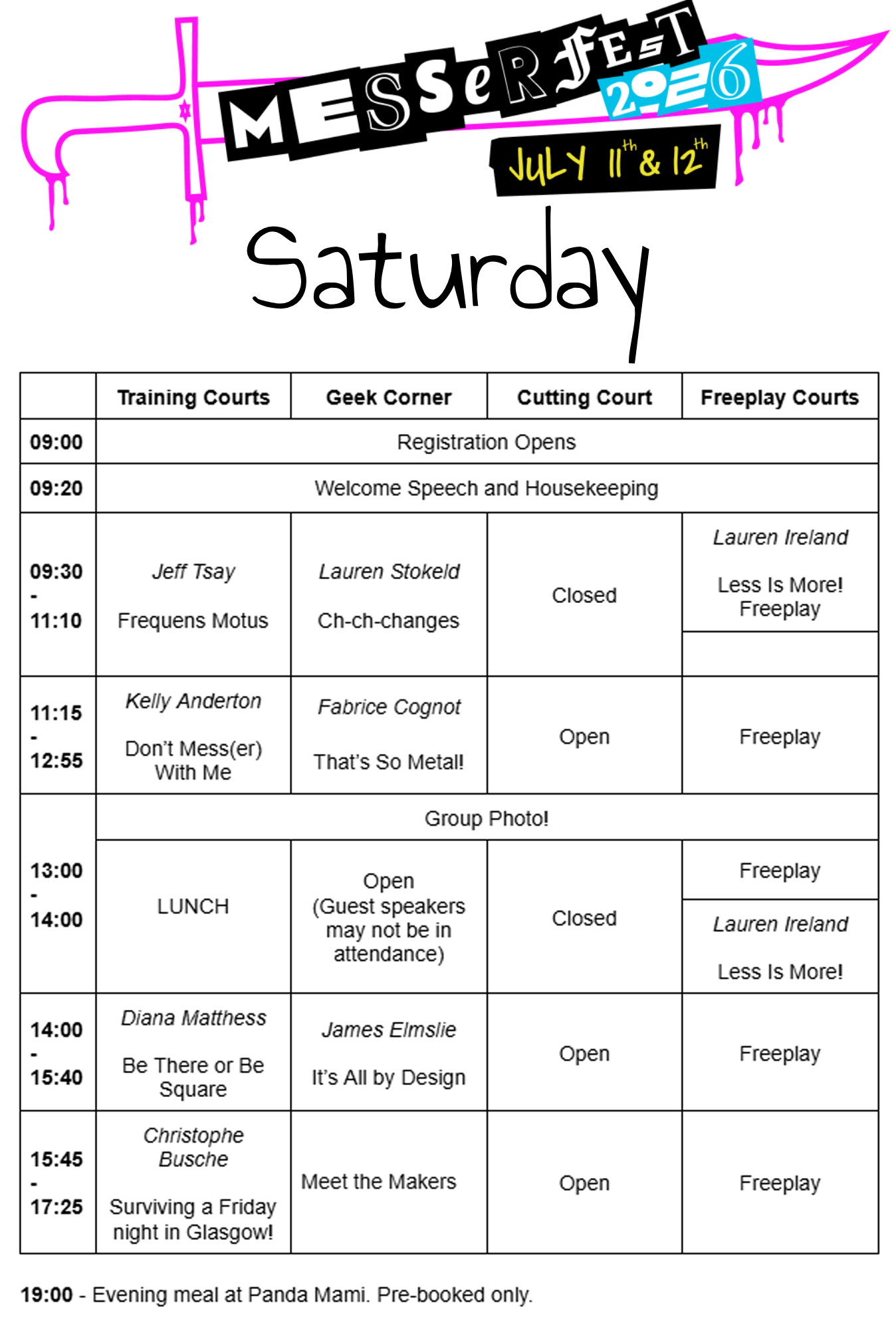
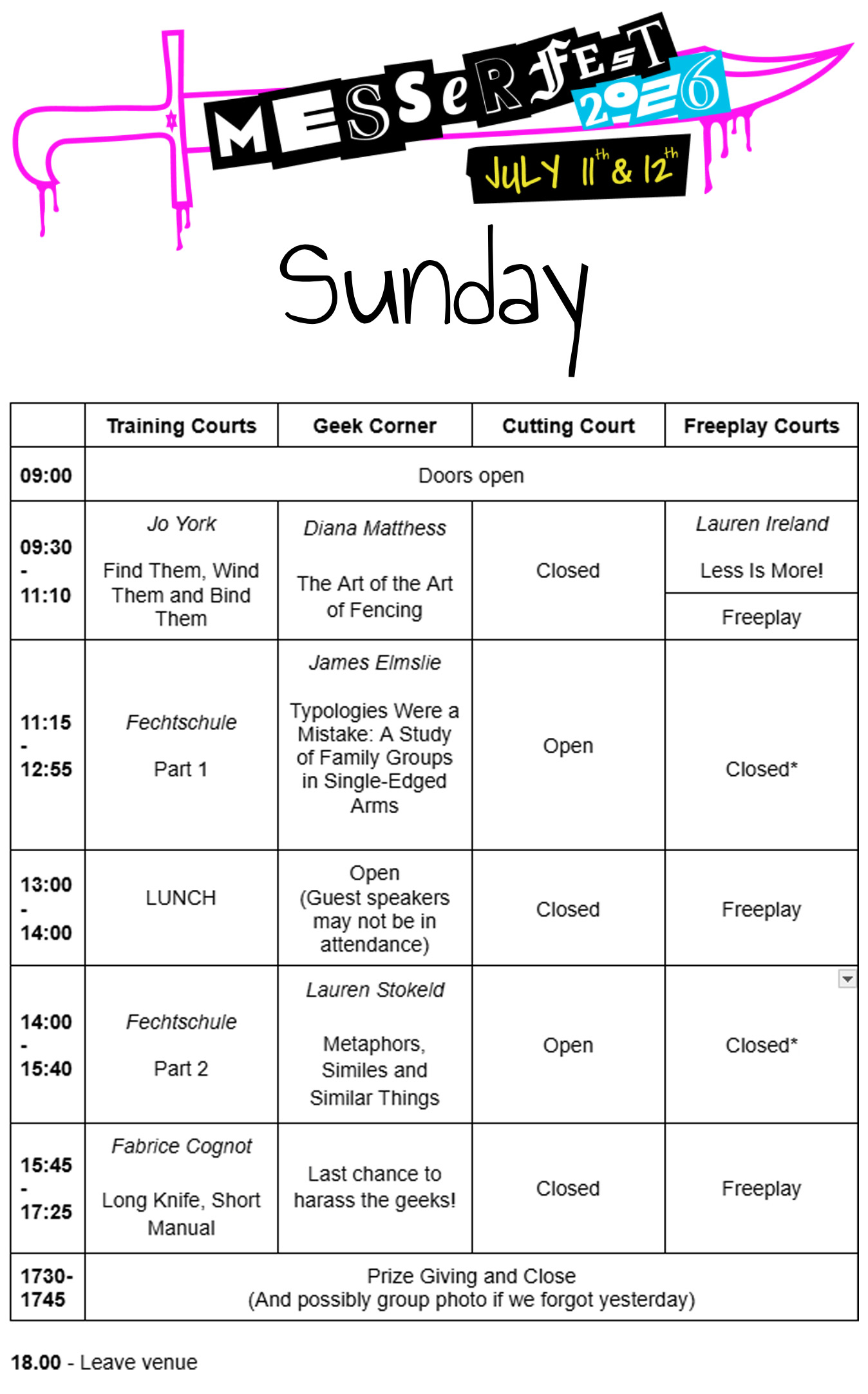
Please visit Geek Corner for Sharps Cutting, additional non-timetabled activities and socialising throughout the weekend.
*Freeplay is limited while the fechtschule is running. If we can designate space to it we will, but that depends on how many participants are in the fechtschule.
Please be respectful of people training in neighbouring arenas and ensure you follow all safety precautions as specified by the organisers and displayed on the “MesserFest Freeplay Rules” displayed around the venue.
Christoph Busche
Sword session: Surviving a Friday night in Glasgow!
Does the Glasgow Fechtbuch (MS E.1939.65.341) describe a purely defensive approach to messer, or is there more it? In this session, we will take a closer look at this short but nuanced source. Breaking up the structure of the text allows us to see how it gives us different options for dealing with specific attacks, and maybe even for using them as a feint or ruse.
You need a messer and a mask, and light gloves if you want. There will be something for every skill level, from “Of course I can recite the complete Lecküchner manuscript by heart!” to “Messer? Ah, that is the name of this metal stick someone just pressed into my hand!”. And if by the end you just had some fun with this “Messer 101” source, that would be “pure dead brilliant”!
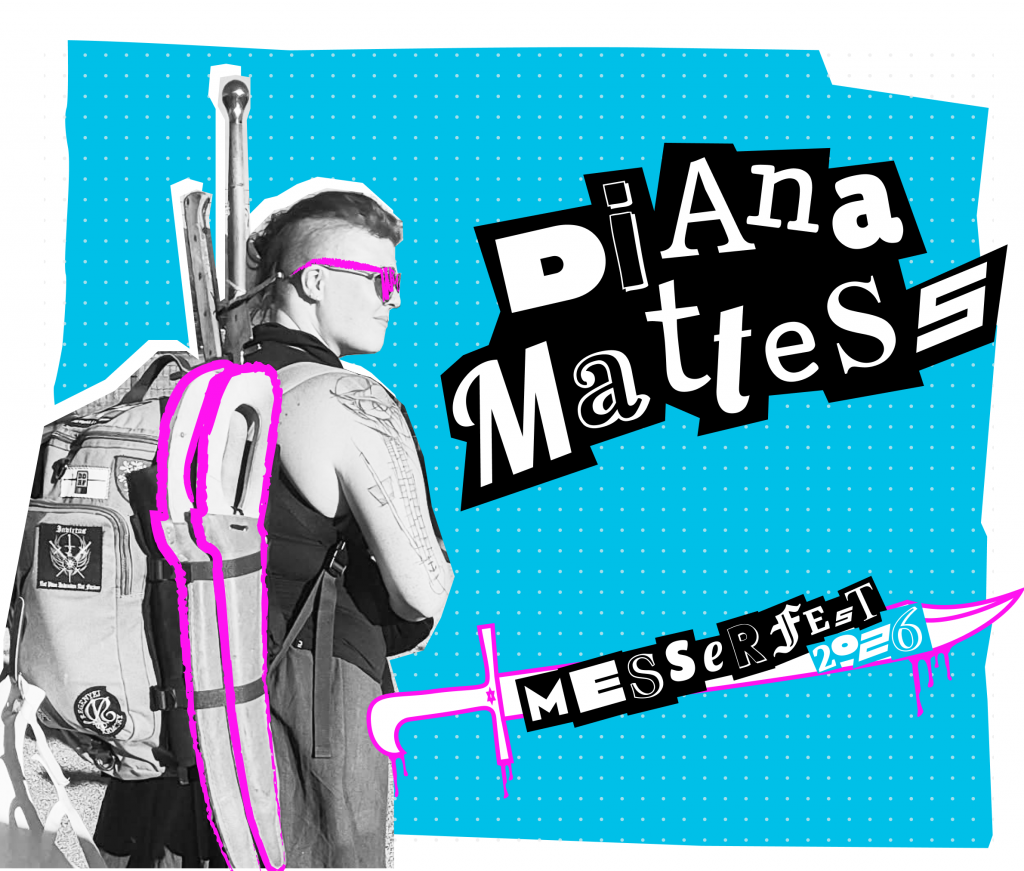
Diana Matthess
Sword session: Be There or Be Square
Back in the sixteenth century, Joachim Meyer gave us a cutting drill that we’re still using today: the Meyer Square. What appears to be a simple diagram of a cross and numbers is actually a powerful training tool in disguise. In this class, we’re going to limber up our minds and bodies by exploring the Meyer Square in depth.
No gear needed – just bring yourself, a positive attitude and a readiness to do lots and lots of diagonal movements.
Geek corner session: The Art of the Art of Fencing
They say a picture is worth a thousand words. And if there’s one thing Albrecht Dürer loved, it’s a good picture. A pioneering artist in his time, Dürer illustrated several fencing masters’ works, creating some of the highest-quality surviving images of messer fighting. In this session, you’ll examine several of the plates from Dürer’s work through the eyes of an instructor who really puts the artist in martial artist.
You might want some gloves for this session – we’re about to get serious.
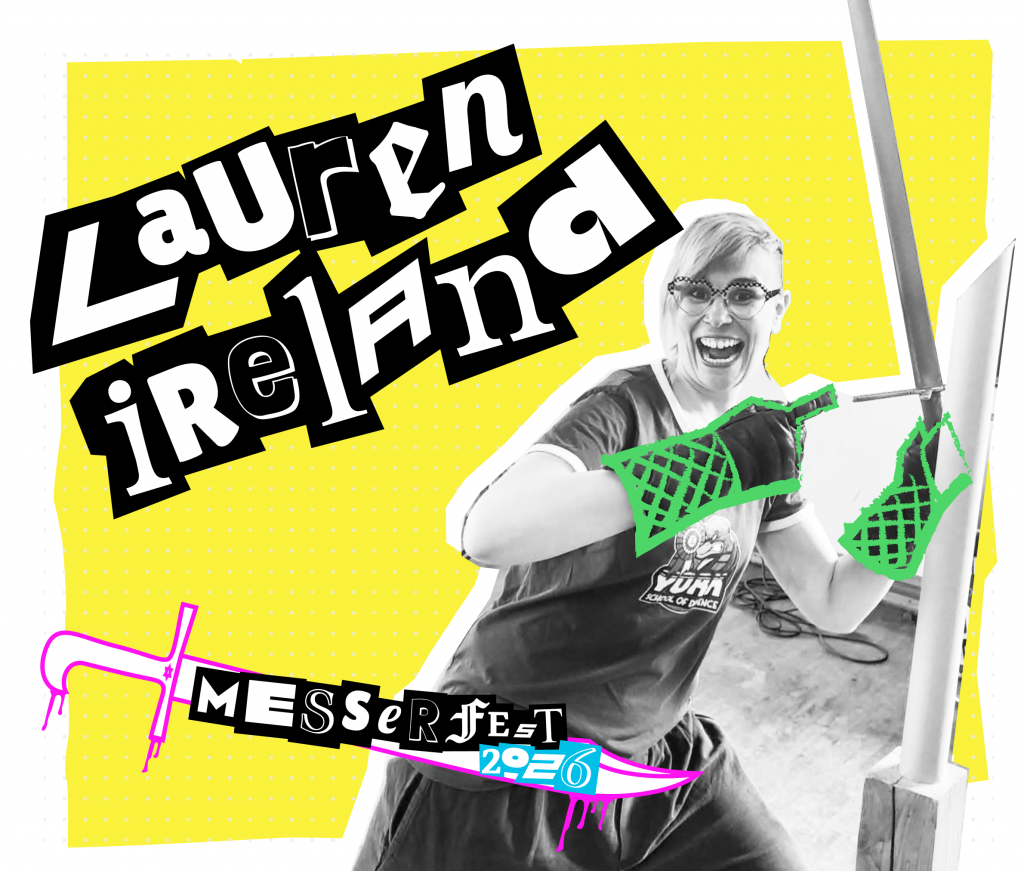
Lauren Ireland
Sword session: Less Is More!
(Attendance of this class is mandatory if you wish to enter the Fechtschule!)
We’re going to put your control and safety to the test by leaving your PPE at home. Chuck it in the bin, set fire to it, make a ritual offering, whatever floats your boat. After this class you’ll be all set of a sexy summer of sparring without the padding.
The most important bit of kit you’ll need is control and good martial sense; we’ll explore the fundamentals of freeplay without dressing up like a moody lobster-clawed overstuffed mattress. We’ll be using structured exercises and games to help you explore concepts like measure, technique, and figure out how to employ mutual respect
Bring a messer, a mask, some light gloves, and if your anatomy requires it make sure you’re wearing a cup/box. A gorget would be highly recommended.
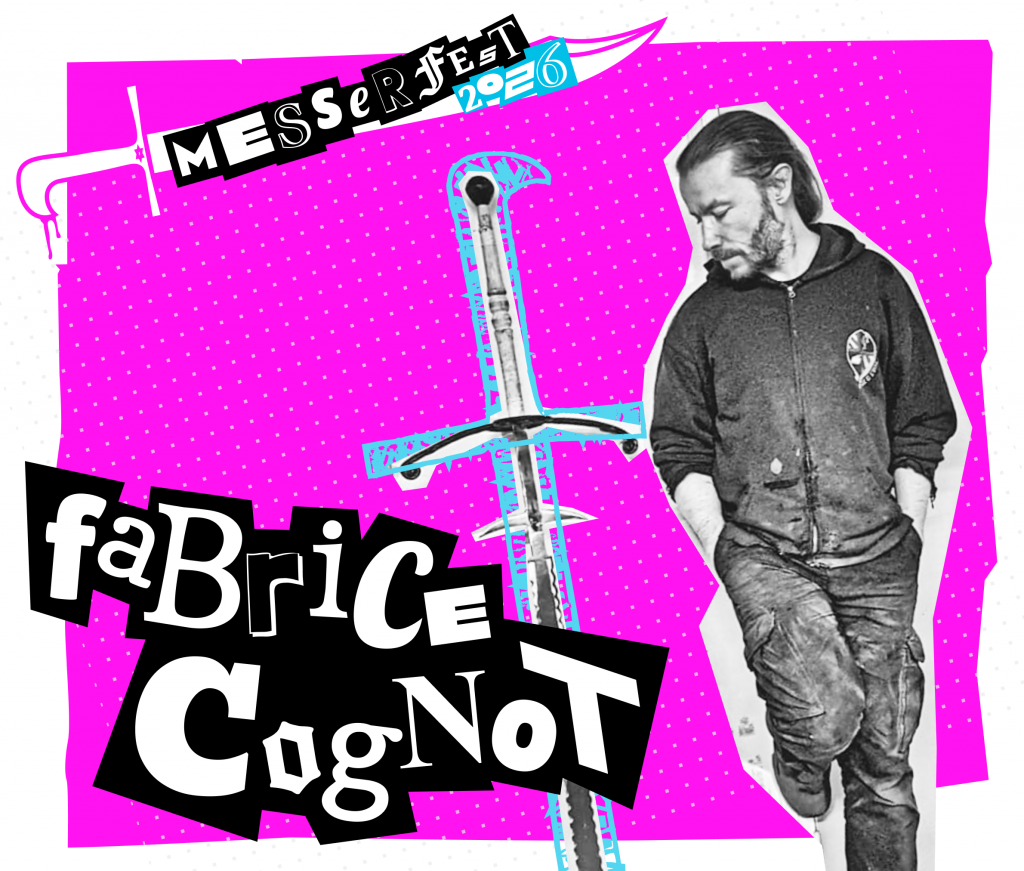
Fabrice Cognot
Sword session: Long Knife, Short Manual
Cod. I.6.4o.2 from Universitätsbibliothek Augsburg, written by Paulus Hector Mair, is one of the so-called Augsburg Group set of manuscripts. Alongside longsword, dagger and grappling, this manuscript contains about eight pages on fighting with the Long Knife. In this session, we shall explore the underlying principles of these pieces, and, time permitting, extend to more plays presented in other sources belonging to the Augsburg Group. We might even sneak in the contraband longsword to see how the messer can hold its own in a clash of weapons.
For this class you’ll need a Messer. Mask and gloves might be useful, and if you fancy lugging a Longsword to a Messer event, you might get some use out of it (no promises).
Geek Corner session: That’s So Metal!
We’re so used to our messers that we don’t always stop to think about the materials they’re made from. But there’s so much we can learn by going back to basics. And we mean right back. All the way to the origins of metal weapons. Join Dr Fabrice, one of our bladesmithing masters, over in Geek Corner to learn about the history of metalworking. Seriously, he’s got a PhD in this! You might hear about tempering metal but there’s no need to temper your expectations of this fascinating talk.
This is the first of a pair of sessions on messer production – so don’t miss James’s follow-up “It’s All By Design” (that’s the name of James’s talk, although his and Fabrice’s fit so perfectly together, you’d think we had planned this or something…..)
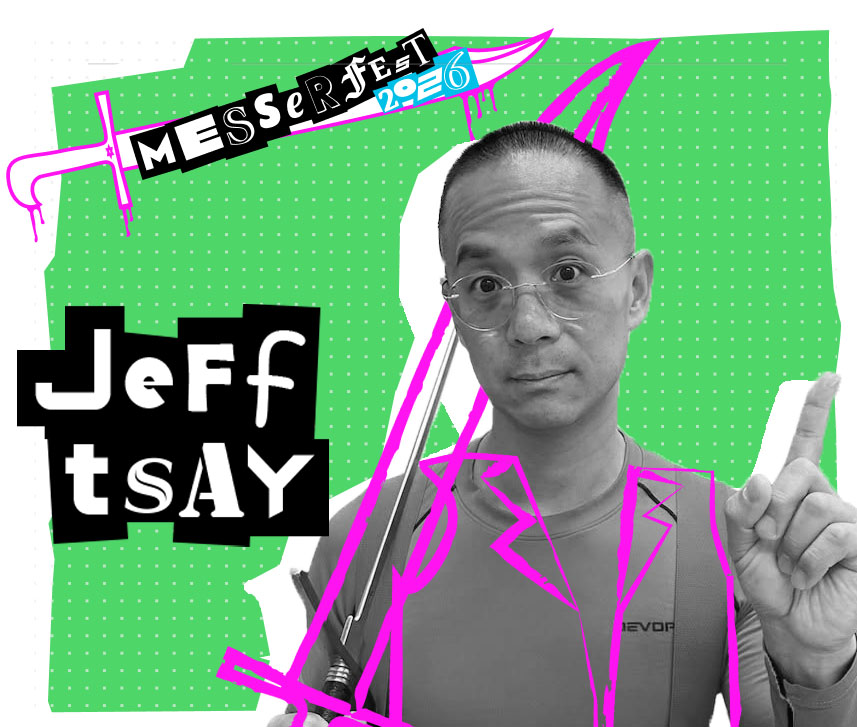
Jeff Tsay
Frequens Motus: A Training Methodology for Universal Principles
We’re excited to welcome Jeff Tsay as a last minute addition to the MesserFest timetable! An expert in the Liechtenauer tradition (he should be after 25 years teaching it!) and usually spotted with a longsword in his hand, Jeff has some deep thoughts on Lecküchner and we’re thrilled he’s made time in his busy schedule so he can share some of these with you all.
The class we have asked him to teach (there were so many to choose from, and they all sounded amazing, but sadly, there’s only time for one) is something we think everyone can benefit from, no matter what their skill or knowledge level. I’m also curious to see if it alters how the Fechschule fencing looks this year.
“Frequens Motus” , For anyone who doesn’t remember their latin, or hasn’t come across this before, it is the concept of perpetual motion while fencing. Jeff has incorporated this into a training methodology for universal principles. Specifically how this can improve how we fence as well as shed some light on the physics and base principles around attacking, defending and movement in general.
Aside from ensuring you’ve had your morning cup of coffee, the only kit requirements for this class are:
Messer
Mask
Light gloves
Groin protection if anatomically required.
Lauren Stokeld
Session 1: Ch-ch-changes
Did you know that ‘nice’ used to mean ‘foolish’? Or that ‘fizzle’ used to mean ‘to fart quietly’? Languages don’t stay still. They change over time, especially the meanings of words. And these shifts can be hard to spot without study. Why does this matter to HEMA? Well, if you’ve ever tried to understand a medieval German manual by googling the modern German definitions of those words, then you may be entitled to compensation. This session will explore why modern languages are not medieval languages and how words we think we understand can fool us.
Bring pen and paper if you want to make notes. Otherwise, just turn up and have fun!
Geek Corner session 2: Metaphors, Similes and Similar Things
We love describing one thing with another: cat-like poise, doing it like a boss, Theseus’s ship. These descriptions might seem straightforward when you know what they mean, but metaphors and similes can be labyrinthine and context is key. What happens if the meaning of ‘boss’ changes? What if you’re using cat-like poise jokily to describe someone with one leg in the air? Reconstructing how to interpret a metaphor from hundreds of years ago can take quite a lot of analysis and sometimes guesswork. So, what does it mean when a swordfighting stance is called ‘Stier/bull’ or a technique called ‘Scorpion’? Get ready to dance your way to a new way of looking at some of the vocabulary in messer manuals.
Bring pen and paper if you want to make notes. Otherwise, just turn up and have fun!
James Elmslie
Geek Corner session 1: It’s All by Design
Have you ever looked at your sword and thought: why are you made like that? Then you’re in the right place! At Messerfest, you’re spoilt with not one but two swordsmithing experts. Following on from Fabrice’s talk, “That’s So Metal”,, messer magnifico James will be considering how different types and treatments of metal can impact messer design. You’ll come away from this talk never able to look at your messer in the same way again!
Geek Corner session 2: Typologies Were a Mistake: A Study of Family Groups in Single-Edged Arms
Single-edged blades have been herded into categories by weapon scholars for many years – but are they actually helpful? Despite the fact that he literally has a messer typology named after him (the Elmslie typology), James is here to argue that they’re a hindrance and not a help! Learn about how typologies can mislead us and why those pesky Victorians are still influencing our thinking to this day. You might not be ready to abandon a good typology yet, but James is going to try his darnedest to change our minds!
Kelly Anderton
Sword session: Don’t Mess(er) With Me
The historical context in which our sources are placed has always interested me nearly as much as the technical aspects of the material itself. I firmly believe that it helps us to really understand why techniques existed and allows us to make better stabs at our interpretations (pun very much intended).
In this class, we will examine the use of Lecküchner’s messer within the context of the medieval town in the Holy Roman Empire and the duties that citizenship placed on townspeople. We will consider why his manuscript includes so many non-lethal and apparently showy techniques when there are easier and simpler options available to use against the same stimulus.
For this class, all you need is a mask and a messer. You’re very welcome to wear gloves and/or forearm protection if you are more comfortable but they are not required.
Note: this class will involve standing grapples and controls, so you should expect person-to-person contact. You are very welcome to build it up slowly and to pair with someone you are comfortable with but most of the class will involve getting close together.
Jo York
Sword session: Find Them, Wind Them and Bind Them
Winding and binding, binding and winding: these techniques are key to good messer fencing, but not enough people use them to their full advantage. Well, no more!
This session is going to do a deep dive into the fine art of the wind and bind. We’ll look at how we can use these techniques to up our messer game, improve trust with our training parters and – most importantly – look prettier than ever while swinging swords around.
The Blossfechten Fechtschule!
Last year we received splendid feedback about the Fechtschule and witnessed some fantastic fencing. The thing that we loved most was how everyone, including attendees who were very nervous and had never wanted to enter any form of HEMA competition before (and had no intention of entering this one either!), jumped straight in and crossed blades with anyone and everyone.
The mandatory intro class, “Less is More” (see timetable) works wonderfully as an ice-breaker and gets everyone into the same frame of mind to ensure there are no nasty surprises when they start working through some of the unknown names on their dance card.
The dance card format removes the need for pools and elimination rounds and ensures that everyone can fence as many people as they could possibly want. It also allows you the flexibility to just step out whenever they need to without feeling the need to dive back in again before they are ready.
Last year we ended up in the middle of a July heatwave, and the lack of traditional HEMA PPE was very much appreciated! It’s so much more pleasant to fence with just a mask and gloves, and the additional mobility this provides was evident in some of the spectacular fencing we witnessed at past events.
So, if you want to enter the most light hearted and lightly padded tournament in British HEMA you should definitely give this one a go. Feel free to go chat to Lauren I at any point during the weekend if there’s anything you’re unsure about, or you need just a little nudge to give you the courage to sign up.
Exclusive First Look!
We’re very excited for this unexpected little exclusive for MesserFest. The super clever and talented fencer, Arnold Shum has just finished a brand new translation of The Art of Combat, by Lienhart Sollinger, 1588. That’s right, there are now even more Messer sources that have been translated into modern English for us to play with!
We’ll have a print out of this unique, obscure text over in Geek Corner, or you can go straight to the Wiktenaur page, https://wiktenauer.com/wiki/Lienhart_Sollinger. Arnold is very keen to discuss his work and your thoughts on it, and he’s keen to discover how his translation works when you folks get your messers out and start to work through it. Feel free to go find him and geek out to your hearts content! Just remember, be polite and check that feedback is welcome before offering it.
Meet the Makers!
Head on over to Geek Corner to meet highly skilled bladesmiths Dr. Fabrice Cognot and James Elmslie. They’re both doing official talks for you, but if you meander over to Geek Corner at any other time, I’m sure one or both of them will be available and happy to chat about their work and expertise. Your main issue may be getting them to stop talking. Especially James…
In addition to this you can pop over to our official “Meet the Makers” Question and Answer Session. This will be an informal, panel-style discussion with not only James and Fabrice, but hopefully with Paul Binns, who has been forging blades for HEMA and the reenactment market since before we even knew HEMA existed.
We’re also pretty sure that if we ask them nicely enough, we can get our three sponsors over for it too!
Kindred (the Caledonian Craftsman) has been working with wood and leather for years, making shields and scabbards for HEMA fencers the world over. Be sure to check out his amazing jewellery as well! That coveted MesserFest pendant… yup, that’s his handy work.
Joe of Joe’s Sword Stuff is single handedly responsible for giving us all the leather goods and adorable shields that bring much needed whimsy and colour into HEMA. If you’ve been wondering how a plushie shark becomes a shield, or how long it takes to cover something in rainbow leather scales, now is probably the perfect time to ask.
Faz of Castell Arms has just exploded onto the scene as HEMA’s new favourite dagger and knife maker, butI suspect once people see the messer he’s made as a prize for our fechtschule and lay their hands on one of his blade-breakers he’ll be drowning in orders for those instead. He promises me he’ll get the website up at some point. On the bright side, he’s spending his time making us blades insead of playing on the internet…. 😃
The Cutting Court!
Chris Halpin will be supervising the cutting court over the weekend. Clay will be out for you to sculpt into all sorts of weird and wonderful shapes, sharp messers will be on hand for you to try, simply drift in and out at your leisure.
We understand that some people like to take things quietly at their own pace without a crowd watching, so we’re limiting the number of people in cutting corner to five at any one time.
If you’re stuck for inspiration of what to do other than a basic oberhau there will be some printed sheets with a few snippets from various manuals for you to peruse to hopefully give you some inspiration. And if you can’t think of any fancy cuts to try you can always try sculpting something absolutely majestic before chopping it to bits.
Please ensure that you properly clean the swords after using them, and clean your shoes and make sure you don’t trapse clay across the antique floor of the Railway Institute.
Don’t bring your own sharps! There will be a small selection for you to play with throughout the day.
You enter the cutting court at your own risk, and whilst there is obviously a risk when using sharp swords you may also end up getting clay on your fancy togs. You have been warned!